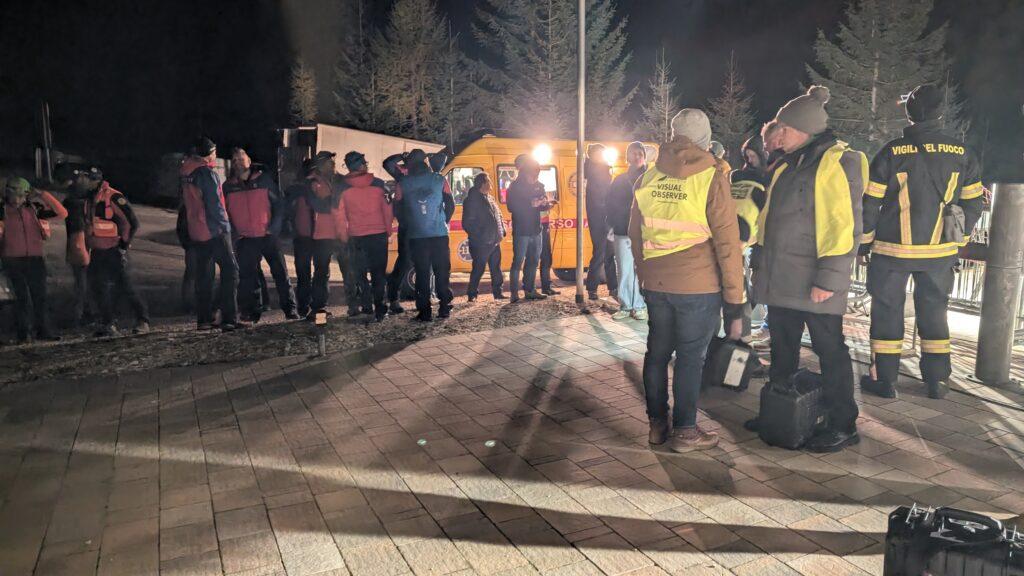
Night, cold, steep rock walls — during Pilot Day 2025 in Belluno, mountain rescuers tested drone operations under real-world conditions. The SIENA team observed where technology meets its limits and where human experience makes the difference.
Night exercise (Oct 10)
Search with thermal imaging and spotlight in zero visibility. Challenges: drone hard to see, sudden gusts, pilot fatigue after 25 minutes, cold impairing fine control. Solutions: position lighting, dedicated spotter, wind limit <12 m/s, pilot rotation after 30 minutes.
Gorge exercise Serrai di Sotto Guda (Oct 11)
Tethered drone as communication relay with total GPS loss. Risks: ATTI mode without GPS, minimal maneuvering room, crash risk over ground personnel. Mitigation: slow manual flight, second operator monitoring clearance, defined no-fly cylinder around the team.
Key takeaways:
Risk assessment often relies on intuition—need for standardized, data-driven tools.
Air-to-ground communication remains a bottleneck; precise position handover lacks protocol.
Role clarity and process standardization matter more than hardware upgrades.
Recommendations:
Minimal risk checklist for rescue drone ops (digitally integrable)
Visual ground markers for faster aerial identification
Standardized BVLOS emergency protocol for the Austria-Italy border region
Real-time geotagging for precise location reporting
Pilot Day 2025 made one thing clear: closing the gap between technological potential and operational reality requires better tools, clearer standards, and smarter communication.
The START Living Lab project receives co-financing from the European Union under the Interreg Italy-Austria programme. Interreg is an EU initiative that funds cooperation between regions and countries, enabling them to address shared challenges together. By supporting collaborative projects across borders, Interreg strengthens regional development, environmental protection, and social and economic ties in Europe.