Zum Inhalt
Forschung @FH-Kärnten Sites > Forschungsgruppe ENABLE > Unkategorisiert > LOXONE SMART HOME ACADEMY

LOXONE SMART HOME ACADEMY

  • von

A training for the Loxone Smarthome Systems took place in Seeboden from 9.3.-12.3.2020. Thanks to an educational cooperation between the company Loxone and Carinthia University of Applied Sciences, two members of the AAL research group, Michael Reiner and Philip Scharf, were among the participants.

The aim of the training was to get a good insight into the functions and programming of the system and to be able to implement this knowledge in smart home projects. The topic of smart homes is of great importance for the AAL research unit, as these technologies support senior citizens in their daily lives and thus help to relieve the burden on caregivers.

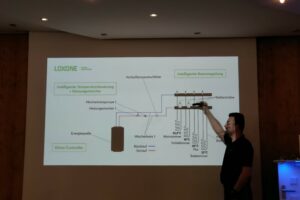
The first day of the four-day training consisted of a theoretical unit about the company and the system. In this unit, the participants got a great overview of the company with insights into the history, structure and activities of Loxone. Another exciting part was the overview of the individual functions of the system.

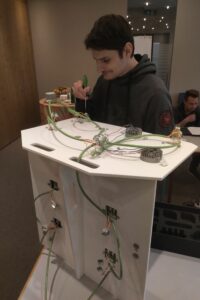
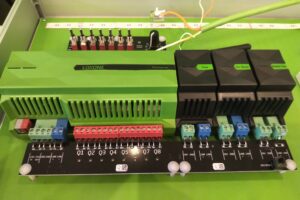
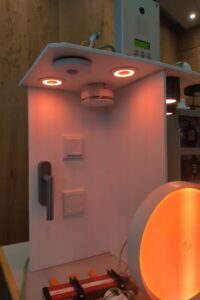
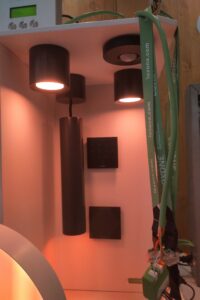
For the remaining days of the training, each team consisting of two people received a test system because the rest of the training was mainly hands-on training. Shortly after receiving the test system, there was a challenge for all teams: which team is able to assemble and wire the test system the fastest. Despite the disadvantage caused by the fact that most of the other teams were trained electricians, our team did well and ended up in the midfield of the participants.

Day two and three of the training consisted of alternating theoretical and practical units on the basic functions of the Loxone system. The functions discussed were:

  • Lighting
  • Shading
  • Heating
  • Cooling
  • Multiroom audio
  • Access solutions
  • Security functions

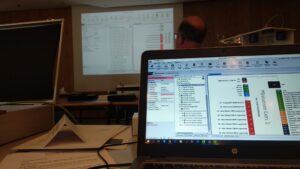
The fourth and last day of the training dealt with project design and automatic configuration of a system. It is very easy to plan a smart home project with the Loxone software. Many steps of the programming are taken over by the software. The more carefully the planning phase is executed, the better it works. At the end of the training there was another challenge to master, in which our team had a slight advantage due to the education and work at CUAS: the planning and partial programming of a project. In this challenge our team emerged victorious delivering a very good time score.

A large part of the newly acquired knowledge can also be used directly in a project of the research group: the smart home demo case. The smart home demo case is a mobile demonstrator to show interested people, for example in schools or care facilities, the advantages of a smart home. Further information on the project will be published in a later report.
 

Schreibe einen Kommentar

Deine E-Mail-Adresse wird nicht veröffentlicht. Erforderliche Felder sind mit * markiert

Forschung @FH-Kärnten Sites > Forschungsgruppe ENABLE > Unkategorisiert > LOXONE SMART HOME ACADEMY

LOXONE SMART HOME ACADEMY

  • von

Vom 9.3.-12.3. fand eine Schulung für das Loxone Smarthome Systems in Seeboden statt. Durch eine Bildungskooperation des Unternehmens Loxone und der Fachhochschule Kärnten waren auch zwei Mitarbeiter der Forschungsgruppe AAL, Michael Reiner und Philip Scharf, unter den Teilnehmern.

Ziel der Schulung war es einen guten Einblick in die Funktionen und die Programmierung des Systems zu bekommen und dieses Wissen in Smarthome Projekten umsetzen zu können. Das Thema Smarthome ist für die Forschungsgruppe AAL von großer Bedeutung, da diese Technologien Senior*innen im täglichen Leben unterstützen und so helfen Pflegekräfte und Betreuer*innen zu entlasten.

Der erste Tag der viertägigen Schulung bestand aus einer Theorieeinheit rund um das Unternehmen und das System. In dieser Einheit erhielten die Teilnehmer einen sehr guten Überblick über das Unternehmen mit Einblicken in die Geschichte, den Aufbau und die Tätigkeiten von Loxone. Ein weiterer spannender Teil war das überblicksmäßige Kennenlernen der einzelnen Funktionen des Systems. Diese reichen von Komfortfunktionen wie der automatischen Steuerung des Lichts und der Beschattung bis hin zu den sicherheitsrelevanten Funktionen Einbrecher- und Brandschutz.

Für die weiteren Tage der Schulung erhielt jedes Team, jeweils bestehend aus zwei Personen, ein Testsystem da der Rest der Schulung hauptsächlich Hands-on Training war. Kurz nach dem Erhalt des Testsystems gab es für alle Teams eine Challange: wer schafft es am schnellsten das Testsystem zusammenzubauen und zu verkabeln. Trotz des Nachteils, dass es sich bei den meisten anderen Teams um ausgebildete Elektroniker handelte, hat sich unser Team gut geschlagen und landete im Mittelfeld der Teilnehmer.

Tag zwei und drei der Schulung bestanden in weiterer Folge aus abwechselnden Theorieblöcken und praktischen Einheiten zu den Grundfunktionen des Loxone Systems. Die besprochenen Funktionen waren:

  • Beleuchtung
  • Beschattung
  • Heizung
  • Kühlung
  • Multiroom Audio
  • Zutrittslösungen
  • Sicherheitsfunktionen

Der vierte und letzte Tag der Schulung hatte das Thema Projektgestaltung und automatische Konfiguration eines Systems. Mithilfe der Software von Loxone ist es sehr einfach ein Smarthome Projekt zu planen. Viele Schritte der Programmierung werden von der Software übernommen, je durchdachter die Planung im Vorfeld ist, desto besser funktioniert das. Am Ende der Schulung gab es wieder eine Challenge zu meistern, bei der unser Team einen leichten Vorteil durch die Ausbildung und der Arbeit an der Fachhochschule hatte: die Planung und teilweise Programmierung eines Projekts. Bei dieser Challange ging unser Team mit einer sehr guten Zeit als Sieger hervor.

Ein großer Teil des neu erworbenen Wissens kann auch direkt in einem Projekt der Forschungsgruppe verwendet werden: dem Smarthome Demokoffer. Der Smarthome Demokoffer ist mobiler Demonstrator um interessierten Personen, zum Beispiel in Schulen oder Pflegeeinrichtungen, die Vorteile eines Smarthomes näher zu bringen. Nähere Informationen zu dem Projekt werden in einem späteren Bericht veröffentlicht.

Schreibe einen Kommentar

Deine E-Mail-Adresse wird nicht veröffentlicht. Erforderliche Felder sind mit * markiert