
Main research areas
Building with concrete, the world’s most widely used construction material, has received new impetus in the last decade through the further development of construction methods and significant advances in concrete technology through to the demand-oriented development of very high-performance concretes.
The further development and establishment of aesthetically sophisticated, reliable and economically viable construction methods should enable the sustainable design of the environment.
Based on the above-mentioned points, the following main topic emerges:
Use of modern material and analysis technologies to research aesthetically sophisticated and resource-saving construction methods.
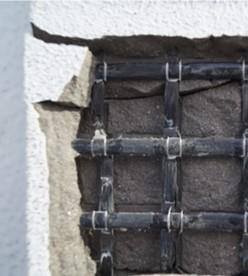
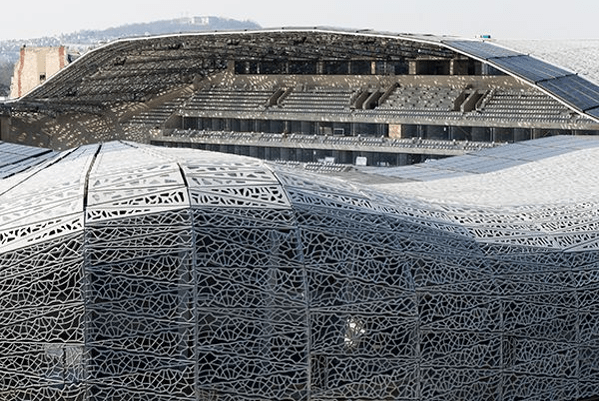
High-performance concrete with carbon reinforcement
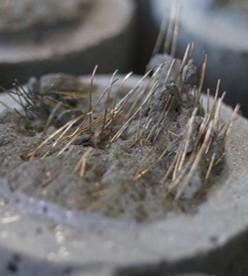
High-performance concrete with steel fiber reinforcement
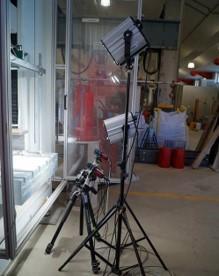
DIC system for the exact recording of changes to the system
Research objectives
The focus is on the further development of efficient, robust high-performance concretes for aesthetically sophisticated construction methods. The objectives include the technical feasibility in Austria and the consideration of an economically justifiable construction method for the sustainable design of the environment. Quality assurance measures and modern building monitoring technologies are intended to ensure the targeted performance over the life cycle of the buildings in the long term.
Current research topics in modern concrete construction, such as the use of increasingly efficient and robust high-performance concretes, will be addressed and further developed with the aim of supporting technical feasibility in Austria.
The modern and innovative technologies required for this are to be researched in a holistic approach, from technical execution and static-constructive aspects to considerations of long-term behavior during use.
What results are being sought?
Methods for the production, quality assurance and dimensioning of innovative concrete construction technology are being investigated in an application-oriented manner for both new and existing buildings, and issues relating to planning and execution as well as long-term use are being developed.
Projects
The following projects are/have been dealt with in the construction laboratory as part of FuCoSo:
Program/Call for Proposals: KS 24/26, KS 24/26, FH – Research for Industry 2024
Long Title: Sustainable reduction of CO2 emissions using precast modular reinforcing elements
Content: The construction industry is responsible for almost one-third of global CO₂ emissions, primarily through the production of materials such as cement, steel, and glass. At the same time, it is indispensable for our infrastructure and housing construction.
The SCORE project is developing innovative, prefabricated concrete elements made of UHPC and F/TRC that can be used in both new and existing buildings. The aim is to minimize environmental impact and extend the service life of buildings.
Advantages for new buildings:
- Reduced use of materials through the targeted combination of high-performance and lightweight materials
- Lower CO₂ emissions and waste volumes
- Improved resistance to environmental influences
- Economic advantages through reduced formwork work
Advantages for existing buildings:
- Extension of service life without demolition
- Sustainable reinforcement through modular retrofit solutions
- Possibility of later upgrading or replacing individual elements
- SCORE stands for sustainable construction – efficient, resource-saving, and economical.
Further information can be found here or by contacting project manager Tamás Mészöly directly.
Program/Call for Proposals: KS 24/26, KS 24/26, FH – Research for Industry 2024
Long Title: Sustainable reduction of CO2 emissions using precast modular reinforcing elements
Content: The construction industry is responsible for almost one-third of global CO₂ emissions, primarily through the production of materials such as cement, steel, and glass. At the same time, it is indispensable for our infrastructure and housing construction.
The SCORE project is developing innovative, prefabricated concrete elements made of UHPC and F/TRC that can be used in both new and existing buildings. The aim is to minimize environmental impact and extend the service life of buildings.
Advantages for new buildings:
- Reduced use of materials through the targeted combination of high-performance and lightweight materials
- Lower CO₂ emissions and waste volumes
- Improved resistance to environmental influences
- Economic advantages through reduced formwork work
Advantages for existing buildings:
- Extension of service life without demolition
- Sustainable reinforcement through modular retrofit solutions
- Possibility of later upgrading or replacing individual elements
- SCORE stands for sustainable construction – efficient, resource-saving, and economical.
Further information can be found here or by contacting project manager Tamás Mészöly directly.
Programme/call for proposals: COIN programme line ‘Aufbau’ (Development), 8th call for proposals: FH – Research for the Economy
Long title: Future Sensor Techniques for in-situ Structural Health Monitoring of Concrete Structures
This research project focuses on the investigation and development of surface acoustic wave sensors (SAW sensors) embedded in reinforced concrete elements to enable real-time monitoring of the condition of structures. The work is in the field of structural health monitoring (SHM), which aims to ensure the safety, longevity and performance of reinforced concrete infrastructures.
An important aspect of the project is the interdisciplinary collaboration between the engineering informatics and civil engineering teams at Carinthia University of Applied Sciences. This collaboration promotes the integration of advanced sensor technology into civil engineering applications with the aim of developing an innovative wireless and energy-autonomous monitoring system. The results of this project could include efficient solutions for assessing the condition of concrete structures, providing valuable data to support maintenance and decision-making processes.
By combining expertise in SAW sensor technology and civil engineering, this project contributes to the further development of SHM technologies and addresses the growing need for reliable solutions.
Further information can be found here or by contacting the project manager Pascal Nicolay directly.
Program/Call for Proposals: WI 24/26, IWI 24/26, Basic Program Call for Proposals 2024
Long Title: Sustainable Design and Construction with Non-Metallic Reinforcement
Content: Non-metallic reinforcement made of fiber-reinforced plastics (FRP) offers high performance and corrosion resistance. It enables a reduction in material mass and prevents damage caused by concrete spalling. The aim of the project is to lay the foundations for the practical application of this type of reinforcement.
Research focus:
- Long-term strength of reinforcement types, especially in low-clinker concrete
- Behavior under dynamic loading and composite behavior with concrete
- Development of design principles for resource-efficient structures
Technical implementation:
- Definition of relevant materials and test methods
- Standardization through round robin tests
- Derivation of manufacturing tolerances and design rules
Sustainable design:
- Development of design models for components subjected to shear forces
- Reinforcement of existing structures with a focus on end anchoring
- Determination of application limits for sustainable construction
The project makes an important contribution to the ecological and economic optimization of concrete construction in Austria.
Further information can be found here.
The Interreg project SITAR (EU co-financed) will help to accelerate the transition of the construction industry to climate-friendly practices in the Alpine region. It will analyse the opportunities offered by modern technologies and advanced approaches to the design, construction, refurbishment and upgrading of buildings from an environmental perspective.
Further information can be found here (project homepage).
Establishment of a new cross-border LivingLab for the investigation and simulation of the fire behaviour of composite materials during and after the fire. Further information can be found here.
Standardised qualification and certification model for Building Information Modelling in Austria
Building Information Modelling (BIM) is the next imminent evolutionary step in the digital planning culture for construction planning and execution in the construction industry. Together with key stakeholders, the leading Austrian universities in the field of civil engineering are developing a coordinated training network with BIM-Zert to broaden the application base and standardise the understanding of BIM in the planning and construction process. The project aims to develop a user-specific, product-independent training concept that culminates in an internationally valid certification for users of Building Information Modelling. Accordingly, BIM-Zert endeavours to familiarise participants with the highly networked, process-oriented and interdisciplinary BIM process, based on the current level of qualification in Austria in the field of digital construction processes, and to enable them to use the necessary tools (in particular the processes) in their own field.
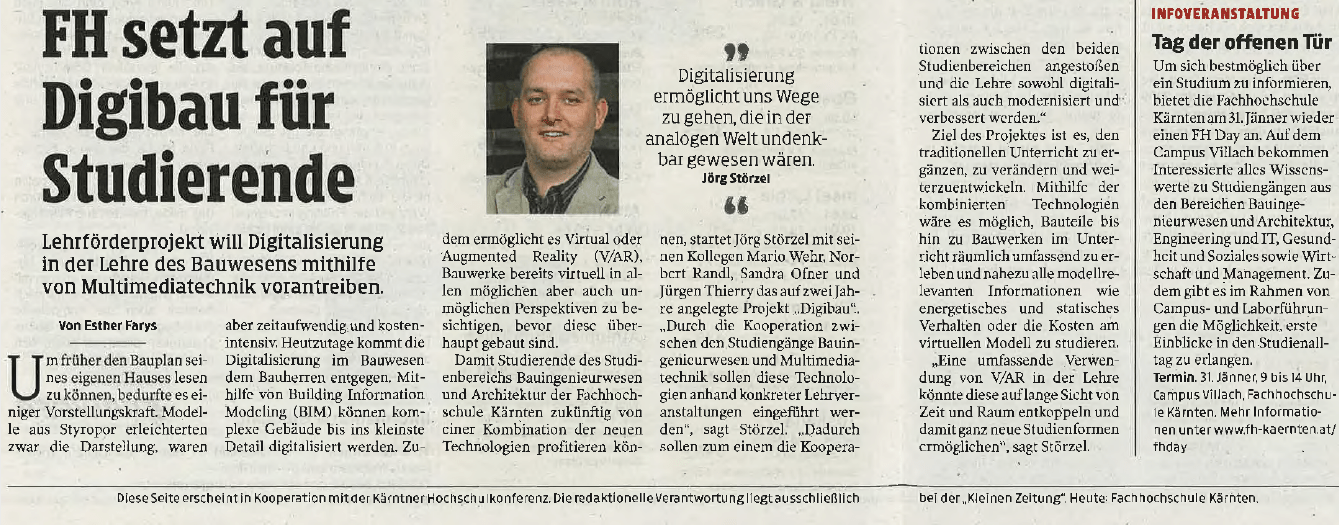
© KleineZeitung

Publications
You can also find a list of current publications here.
Freytag, B., Huß, M., Mayer, M., Randl, N., Tue, N.: “Brückensanierung mit UHFB in Österreich.”, Beton- und Stahlbetonbau, 120:79-89, 2025.
Guo, W., Ding, Y., Randl, N.: “Effect of macro polyoxymethylene fibers on shear transfer across a crack and crack surface topography of concrete.”, Construction and Building Materials, 464:1-16, 2025.
Meszöly, T., Randl, N.: “Assessment of Methods to Derive Tensile Properties of Ultra-High-Performance Fiber-Reinforced Cementitious Composites.” Materials, 17:1-44, 2024.
Rossi, E., Randl, N., Meszöly, T., Harsanyi, P.:” Experimental investigation on shear strengthening with fiber/textile reinforced concrete.”, Structural Concrete, 25:537-548, 2024.
Rossi, E., Randl, N.: “Interaction between F/TRC shear strengthening and steel stirrups: Experimental observations on real-scale RC T-beams.” Engineering Structures, 325:1-12, 2024.
Wang, X., Strauss, A., Randl, N., Bocchini, P.: “Uncertainty quantification in the strain response of prestressed reinforced concrete structures using fractile based sampling. Structure and Infrastructure Engineering”, 20:771-789, 2024.
Mattarollo, G., Randl, N., Pauletta, M.: “Investigation of the Failure Modes of Textile-Reinforced Concrete and Fiber/Textile-Reinforced Concrete under Uniaxial Tensile Tests.”, Materials, 16:1-30, 2023.
Rossi, E., Randl, N., Harsanyi, P., Meszöly, T.: “Experimental study of fibre-reinforced TRC shear strengthening applications on non-stirrup reinforced concrete T-beams”, Engineering Structures, 256:1-13, 2022.
Harsanyi, P., Randl, N., Tue, N.: “DIC-based failure analysis of high-strength continuous steel shear dowels for composite UHPFRC steel construction”, Engineering Structures, 247:1-17, 2021.
Rossi, E., Randl, N., Harsanyi, P., Meszöly, T.: “Overlapped joints in Textile Reinforced Concrete with UHPC matrix: An experimental investigation”, https://doi.org/10.1617/s11527-021-01739-1. Materials and Structures, 54 / 152. 2021.
Rossi, E., Randl, N., Meszöly, T., Harsanyi, P.: “Effect of TRC and F/TRC strengthening on the cracking behaviour of RC beams in bending”, Materials, 14(4863):1-19. 2021.
Rossi, E., Randl, N., Meszöly, T., Harsanyi, P.: “Flexural Strengthening with Fiber-/Textile-Reinforced Concrete”, ACI Structural Journal, 118/4:97-107, 2021.
Wang, Q., Ding, Y., Randl, N.: “Investigation on the alkali resistance of basalt fiber and its textile in different alkaline environments”, DOI: 10.1016/j.conbuildmat.2020.121670. Construction and Building Materials, 272, 2021.
Meszöly, T., Ofner, S., Randl, N.: “Effect of Combining Fiber and Textile Reinforcement on the Flexural Behavior of UHPC Plates”, Advances in Materials Science and Engineering, 2020.
Pauletta, M., Rovere, N., Randl, N., Russo, G.: “Bond-Slip Behavior between Stainless Steel Rebars and Concrete”, Materials, 13 / 979, 2020.
Randl, N., Steiner, M.: “Hochfester Aufbeton zur Tragwerksverstärkung – Teil 2: Bauteilversuche”, Beton- und Stahlbetonbau, 115 / 5:375-384, 2020.
Randl, N., Steiner, M., Peyerl, M.: “Hochfester Aufbeton zur Tragwerksverstärkung – Teil 1: Kleinkörperversuche”, Beton- und Stahlbetonbau, 02/2020, Verlag Wilhelm Ernst and Sohn
Zanotti, C., Randl, N.: “Are concrete-concrete bond tests comparable?” Cement and Concrete Composites, Vol. 99 (2019) 80–88, Elsevier 2019, https://doi.org/10.1016/j.cemconcomp.2019.02.012
Mészöly, T., Randl, N.: “An advanced approach to derive the constitutive law of UHPFRC”, Architecture, Civil Engineering, Environment (ACEE), 2018(1) pp. 89–96, The Silesian University of Technology 2018, ISSN: 1899-0142
Mészöly, T., Randl, N.: “Shear behavior of fiber-reinforced ultra-high performance concrete beams”, Engineering Structures, Volume 168, pp. 119–127, Elsevier 2018, ISSN: 0141-0296, https://doi.org/10.1016/j.engstruct.2018.04.075
Meszöly, T., Ofner, S., Randl, N.: “Flexural behavior of fiber/textile-reinforced ultra-high performance concrete plates”, in: fib Symposium 2020, 22-24 Nov 2020, Online, Shanghai, S. 240-247.
Randl, N.: “Innovative approaches for strengthening existing concrete structures”, in: MATEC Web of Conferences (Hrsg.), 10th International Conference of Advanced Models and New Concepts in Concrete and Masonry Structures (AMCM 2020), 21-23 Oct 2020, Online, Lublin.
Randl, N., Harsanyi, P.: “Efficient and low invasive strengthening of existing concrete structures in shear. in: IABSE (Hrsg.), IABSE SYMPOSIUM Wroclaw 2020 “Synergy of Culture and Civil Engineering – History and Challenges”, 07-09 Oct 2020, Wroclaw, S. 710-717
Randl, N., Steiner, M., Far, B., Som, D., Zanotti, C.: “Extension of MC2010 concrete-concrete-bond design recommendations to high performance materials”, in: fib Symposium 2020, 22-24 Nov 2020, Online, Shanghai, S. 2146-2153.
Rossi, E., Randl, N., Meszöly, T., Harsanyi, P.: “Damage and failure mechanisms associated with stress transfer of textile overlap joints in textile reinforced concrete. in: IABSE (Hrsg.), IABSE SYMPOSIUM Wroclaw 2020 “Synergy of Culture and Civil Engineering – History and Challenges”, 07-09 Oct 2020, Wroclaw, S. 718-725
Rossi, E., Randl, N., Meszöly, T., Harsanyi, P.: “Damage and failure mechanisms associated with stress transfer of textile overlap joints in textile reinforced concrete”, in: IABSE (Hrsg.), IABSE SYMPOSIUM Wroclaw 2020 “Synergy of Culture and Civil Engineering – History and Challenges”, 07-09 Oct 2020, Wroclaw, S. 718-725.
Meszöly, T., Ofner, S., Randl, N.: “Mechanical properties of glass and carbon textile reinforced UHPC”, in: fib-Symposium 2019: Concrete – Innovations in Materials, Design and Structures, 27-29 May 2019, Krakow, S. 289-296.
Mészöly, T., Randl, N.: “Shear behaviour of UHPC beams – Effect of fibres and stirrups”, Proceedings of the fib Symposium 2019: Concrete – Innovations in Materials, Design and Structures, Krakow 2019, p. 1866-1871, ISBN 978-2-940643-00-4.
Zanotti, C., Randl, N., Steiner, M., Gar, P.S., Far, B.K.: “Bond between concrete substrates and high performance repair layers”, Proceedings of the fib Symposium 2019: Concrete – Innovations in Materials, Design and Structures, Krakow 2019, p. 1659-1666, ISBN 978-2-940643-00-4.
Mészöly, T., Ofner, S., Randl, N.: “Mechanical properties of glass and carbon textile reinforced UHPC”, Proceedings of the fib Symposium 2019: Concrete – Innovations in Materials, Design and Structures, Krakow 2019, p. 289-296, ISBN 978-2-940643-00-4.
Randl, N., Zanotti, C.: “Concrete to concrete bond – a critical review on methods for bond strength determination”, Proceedings of the 2018 fib Congress, Melbourne, Australia, p. 2294-2301, fib 2018, ISBN 978-1-877040-15-3
Randl, N., Kunz, J.: “Bond splitting behavior of post-installed and cast-in reinforcing bars”, Proceedings of the 2018 fib Congress, Melbourne, Australia, p. 2273-2283, fib 2018, ISBN 978-1-877040-15-3
Randl, N., Harsanyi, P.: “Advanced shear strengthening techniques for RC members”, Proceedings of the 2018 fib Congress, Melbourne, Australia, p. 1802-1812, fib 2018, ISBN 978-1-877040-15-3
Randl, N., Ricker, M., Häusler, F.: “Pre-fabricated UHPC composite element for punching shear enhancement”, Proceedings of the 2018 fib Congress, Melbourne, Australia, p. 2793-2802, fib 2018, ISBN 978-1-877040-15-3 Randl, N., Steiner, M., Far, B., Som, D., Zanotti, C.
Randl, N., Harsanyi, P.: Nachträgliche Maßnahmen zur Querkraftverstärkung, Tagung „Querkraftnachweise für Bestandsbrücken“, 14.03.2019, TU Wien – Kuppelsaal, Tagungsband, ISBN 978-3-200-06499-7
Randl, N., Mészöly, T.: “Fibre effect on shear behaviour of UHPC beams”, 3rd FRC International Workshop, Conference proceeding, In: Massicotte B., Minelli F., Mobasher B., Plizzari G. (eds) Fibre Reinforced Concrete: from Design to Structural Applications, pp. 158–159, Cartoliberia Snoopy 2018, ISBN 978-88-89252-44-4
Zanotti, C., Randl, N., Gar, P.S., Far, B.K., Steiner, M.: “Comparability of bond tests for repair and retrofit of concrete structures with Fiber Reinforced Concrete”, 3rd FRC International Workshop, Conference proceedings, In: Massicotte B., Minelli F., Mobasher B., Plizzari G. (eds) Fibre Reinforced Concrete: from Design to Structural Applications, pp. 56-57, Cartoliberia Snoopy 2018, ISBN 978-88-89252-44-4
Ofner, S., Hofer, B., Randl, N.: UHPC mit Textilbewehrung – ein nachhaltiger Verbundbaustoff, in: Tagungsband zum 12. Forschungsforum der Österreichischen Fachhochschulen, 2018, 8 S.
Randl, N.: Textilbewehrter UHPC – Mechanische Eigenschaften und Tragverhalten als Aufbeton, Tagungsband der 10. Carbon- und Textilbetontage, Dresden, 2018, S. 68-69
Team
FH-Prof. DI Dr. Norbert Randl
Head of research group
+43(0)590500-5112
n.randl@fh-kaernten.at
Dr. Giorgio Mattarollo
Research assistant +43(0)590500‐5114 g.mattarollo@fh-kaernten.at
Tamas Meszöly, MSc.
Research assistant
+43(0)590500-5135
t.meszoely@fh-kaernten.at
DI Sandra Ofner, BSc.
Research assistant
+43(0)590500-5138
s.ofner@fh-kaernten.at
DI Martin Steiner, BSc.
Research assistant
+43(0)590500-5120
m.steiner@fh-kaernten.at
Dr.-Ing. Antroula Georgiou
Research assistant
+43(0)590500-5119
a.georgiou@fh-kaernten.at
Dr. Xiujiang Shen Senior Researcher +43 (0)5 90500-5125 x.shen@fh-kaernten.at
Lazar Azdejkovic, MSc PhD Research assistant
+43(0)590500‐5109
l.azdejkovic@fh-kaernten.at
Former employees
Peter Harsanyi, M.Eng
Research assistant
+43(0)590500-5136
p.harsanyi@fh-kaernten.at
FH-Prof. DI Dr. Martin Schneider
Head of Building Materials Technology
+43(0)590500-5111
m.schneider@fh-kaernten.at
Dipl.-Ing. Jörg Störzel
University lecturer
+43(0)590500-5122
j.stoerzel@fh-kaernten.at
Edoardo Rossi, Ph.D.
Research assistant
+43(0)590500-5141
e.rossi@fh-kaernten.at