When AI Reads Monkey Faces
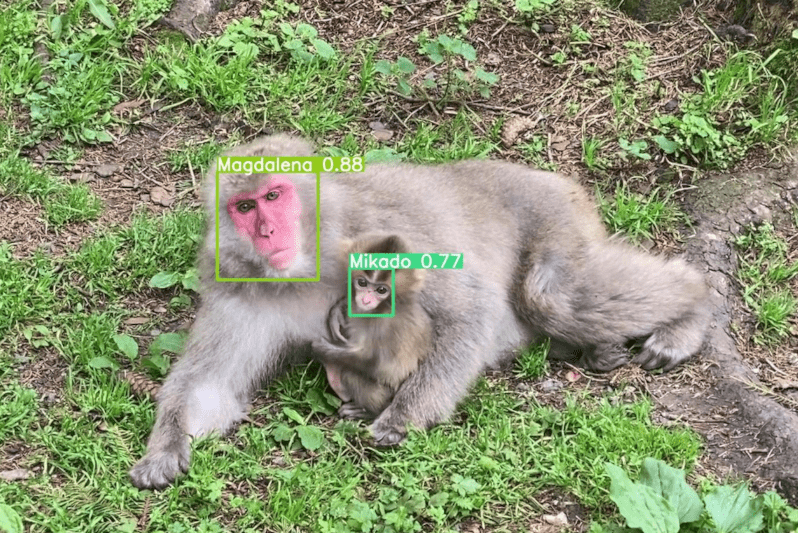
The technology that helps unlock smartphones is now being applied in primate research: As part of the Smart Monkey Lab project at Affenberg Landskron, artificial intelligence is used to automatically recognize and distinguish each of the 181 individual Japanese macaques based on their faces.

AI-based recognition of monkey faces

Facial recognition algorithms are widespread in everyday life. However, individual identification of animals poses a particular challenge in wildlife research. Japanese macaques display subtle but distinct facial features – from the shape of the eye region and nose structure to individual fur patterns around the face. The Smart Monkey Lab leverages these characteristics.

A deep learning-based AI model is trained on thousands of macaque photos to detect faces, extract them, and assign them to specific individuals. The system learns to weight relevant features and deliver reliable identifications even under varying lighting conditions, or different head positions.

Why Facial Recognition Matters for Research

Automatic identification of individual animals enables more precise behavioral studies. Instead of relying on manual notes or labor-intensive video analysis, researchers can systematically capture large datasets: Who interacts with whom? How do social contacts change after enclosure expansion? Which individuals are the first to explore new habitat areas?
Such questions are central to understanding social dynamics in Japanese macaques, whose group structures are comparable to human social networks. AI-powered facial recognition provides the technical foundation for collecting long-term data objectively and reproducibly.

Animal Welfare at the Core

A key advantage of this non-invasive technology: animals do not need to be captured or marked. Recognition occurs exclusively via image data collected from a safe distance – whether through fixed cameras, mobile recording devices, or drones. This aligns with the project’s ethical commitment to conduct behavioral research with minimal interference in the animals’ natural behavior.

Technical Implementation in the Smart Monkey Lab

Development of the facial recognition system is carried out in close collaboration between behavioral biologists from the University of Vienna and digital experts from the Carinthia University of Applied Sciences. The workflow includes:

  • Collection of high-quality image and video data in the field
  • Annotation and preparation of data for AI model training
  • Development and fine-tuning of a recognition model specialized for macaques

The goal is a robust system that is practical for everyday use at Affenberg and can also be utilized by park staff or within citizen science formats.

Next Steps

Facial recognition is a core component of the Smart Monkey Lab and will be gradually integrated with additional technologies such as thermal drone remote sensing and spatial analysis methods. The insights gained and tools developed have the potential to be applied in other zoos, wildlife parks, or research projects worldwide.

The Smart Monkey Lab project is funded by the Austrian Research Promotion Agency (FFG) as part of the BRIDGE program (project no. 4639393, duration 2023-2026).